- 2 min read


Existing customer?

As featured in Gasworld: January 2025
As the market landscape becomes increasingly complex for distributors, new technologies are rising to the occasion to help meet the latest business challenges.
These next-generation tools are designed to bring more intelligence to the supervision of inventory assets and to introduce new efficiencies into routing and other day-to-day operations.
Specialized hardware and software advances are making it easier to stay competitive and achieve business growth when the costs of products and labor continue to escalate. As the solutions advance, so do the demands, so let’s look at some of the most noteworthy trends today in telemetry and gases.
Connectivity anywhere
Telemetry has already established itself as a go-to technology for many distributors, with others now following suit and integrating the tools into their operations. Despite its progress, however, there are still some settings where modern remote monitoring hasn’t been possible due to the power requirements for the transmitting devices. These include offshore deployments, construction sites, and other “unplugged” environments where it’s important to track inventories but there’s no available power to drive a conventional telemetry system.
Plus, to date, it has been costly and cumbersome to fit-out individual tanks at scale with the technology needed for fully autonomous sensing and reporting. The existing market solutions have not only been bulky and expensive, but they could also only provide readings once or twice per day – and they usually don’t connect to all cellular carriers.
Several companies have been working to solve these challenges, with San Francisco-based Pulsa being one that has made important strides. The company recently launched its Frontier line to provide cellular connectivity and GPS in a compact, cost-effective solution that makes it practical to deploy at scale. It’s notable for offering improved battery life on many of the incumbent techs – 20 years of life is quoted – and data gathering every 15 minutes, which again is a step-change compared with most platforms.
For those assessing their operations, ease of adoption and hassle-free management are perhaps the first considerations when it comes to telemetry. It means that systems that auto-connect to cellular networks and integrate into other user dashboards are therefore especially attractive, Additionally, in-built GPS for location tracking of assets is now a given.
04f6.png?width=4614&height=1952&name=Cell3_0068%201%20(1).png) Pictured: Pulsa Frontier with a Pulsa Frontier DP and Pulsa Frontier Pressure sensor connected. Connect any device with a 0-5V or 4-20mA output to the Pulsa Frontier. Pulsa makes custom connectors for the most popular devices.
Pictured: Pulsa Frontier with a Pulsa Frontier DP and Pulsa Frontier Pressure sensor connected. Connect any device with a 0-5V or 4-20mA output to the Pulsa Frontier. Pulsa makes custom connectors for the most popular devices.
Greater data integration
As distributors have looked to bring measuring technologies into their assets, many have used more than one supplier. While this diversity
has delivered flexibility and a level of integration, there have been some challenges along the way. Data management is one example that can become too complex, as some have found. If a company has a few different systems that don’t ‘talk’ all that effectively, problems arise.
In response to this integration challenge, today’s telemetry industry is busy developing systems that can deal with inputs from various devices.
Pulsa’s Frontier Link, for example, enables distributors to consolidate all asset and gas-usage data into a single cloud platform, collecting data from a range of industry sensors. Combined with its own low-power, high-durability sensors, it is a powerful proposition.
These kinds of advances mean distributors now don’t have to start again with systems. Instead, they can adapt seamlessly and save money.
Assistive software
Of course, on its own data tells only a partial story. A sensor can
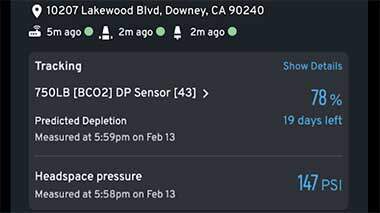
tell how much is left in a tank, but the distributor needs a picture that includes many more details. When was the last fill? Are fills happening too frequently? If so, why? And by how much? Answers to questions like these let distributors plot better routes and deliver better service.
The telemetry providers are working on providing ever more usable data and the difference it can make for customers. Ultimately, they want to best serve their customers in a competitive market, so creating assistive software tools to deliver value is the name of the game.
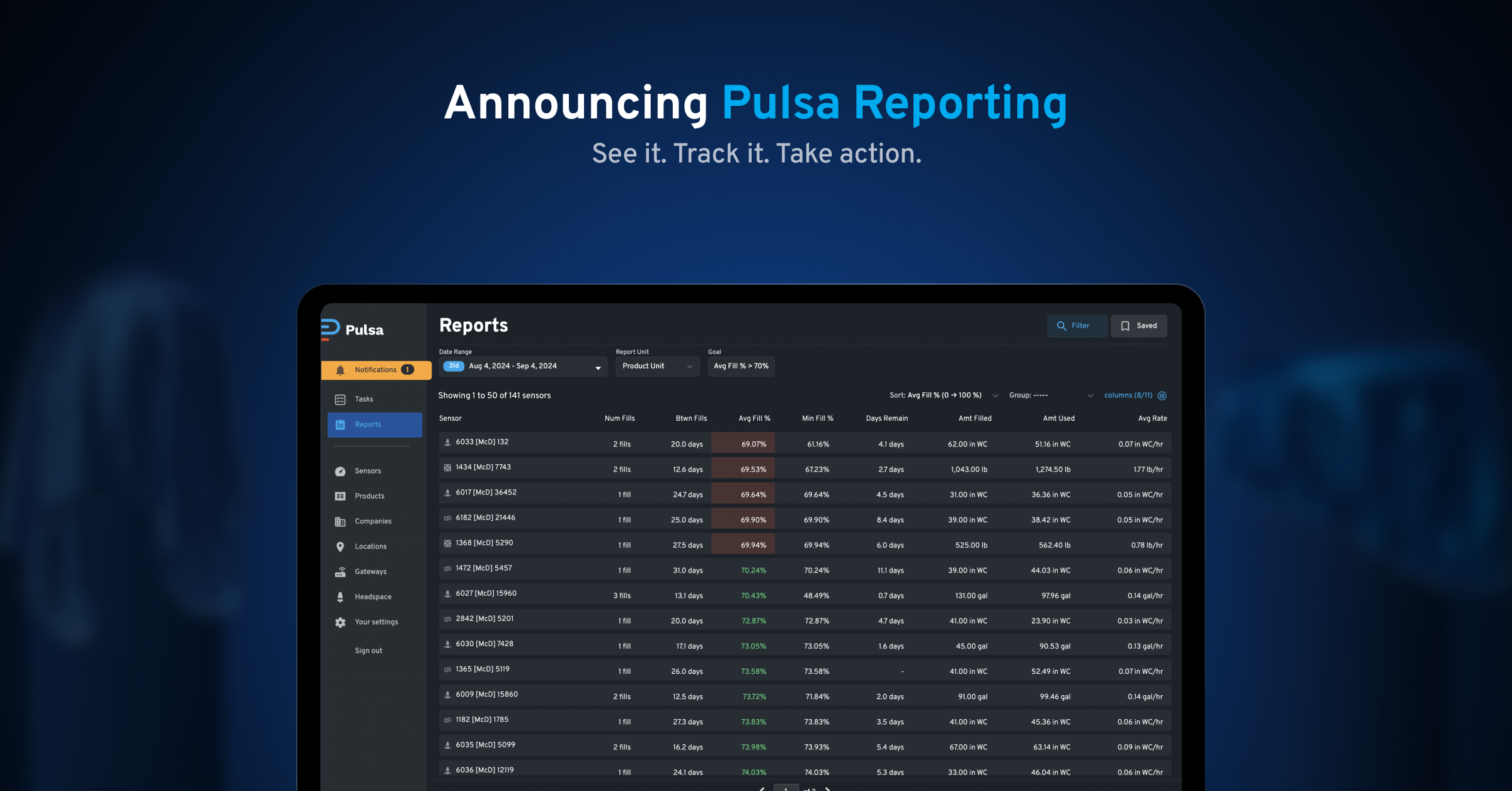
Pulsa Reporting is one offering on the market today that enhances the offer with further actionable insights by analyzing historical usage data, identifying patterns, and reducing inefficiencies. In the process, it turns the telemetry system into a practical ERP tool for confident decision-making.
AI capabilities
While telemetry is still being adopted by the industry, next-generation technologies are also being introduced all the time. In the past year, for example, generative AI has started to have more of an impact, with some providers, like Pulsa, stealing a march on others.
The early-gen AI pilots have already yielded value – and now those successes are driving more investment. In a recent Deloitte survey, two-thirds of businesses said they were increasing investments in gen AI.
When it comes to distributor businesses in the US today, more than half (54.03%) believe that AI will give them a competitive edge, with only just over 3% of distributors believing that the technology is not important at all. One benefit that flows from machine learning is its capacity to keep track of changes – or an unexpected lack of changes – by watching for anomalies that might signal equipment malfunction or leaks, and then provide insights into how to optimize.
These technologies are complex, of course, and require dedicated personnel to drive developent. At Pulsa, the company’s Chief Technology Officer, a Stanford graduate with twin degrees in Computer Science and Machine Learning, heads its AI-related projects. Since engaging with the benefit of such tools, Pulsa has begun developing a competitive edge that should grow over time.
A new era for asset management
Let’s sign off by noting this. These innovations are not from the future: they are here and making a difference today. Beyond the impact they’re having on distributors of all sizes, they point to an even more interesting path forward where all assets will be digitally represented and addressable. And today’s tech represents an early iteration, with more profound changes to come. The message is to stay attuned – and to try to gain some early-mover advantage.